Quick answers
What is Cerebrolysin and what is it used for in research?
How does Cerebrolysin work?
What is the typical Cerebrolysin research dose?
Where can I buy Cerebrolysin in Thailand?
How fast can Cerebrolysin be delivered in Thailand?
What is Cerebrolysin?
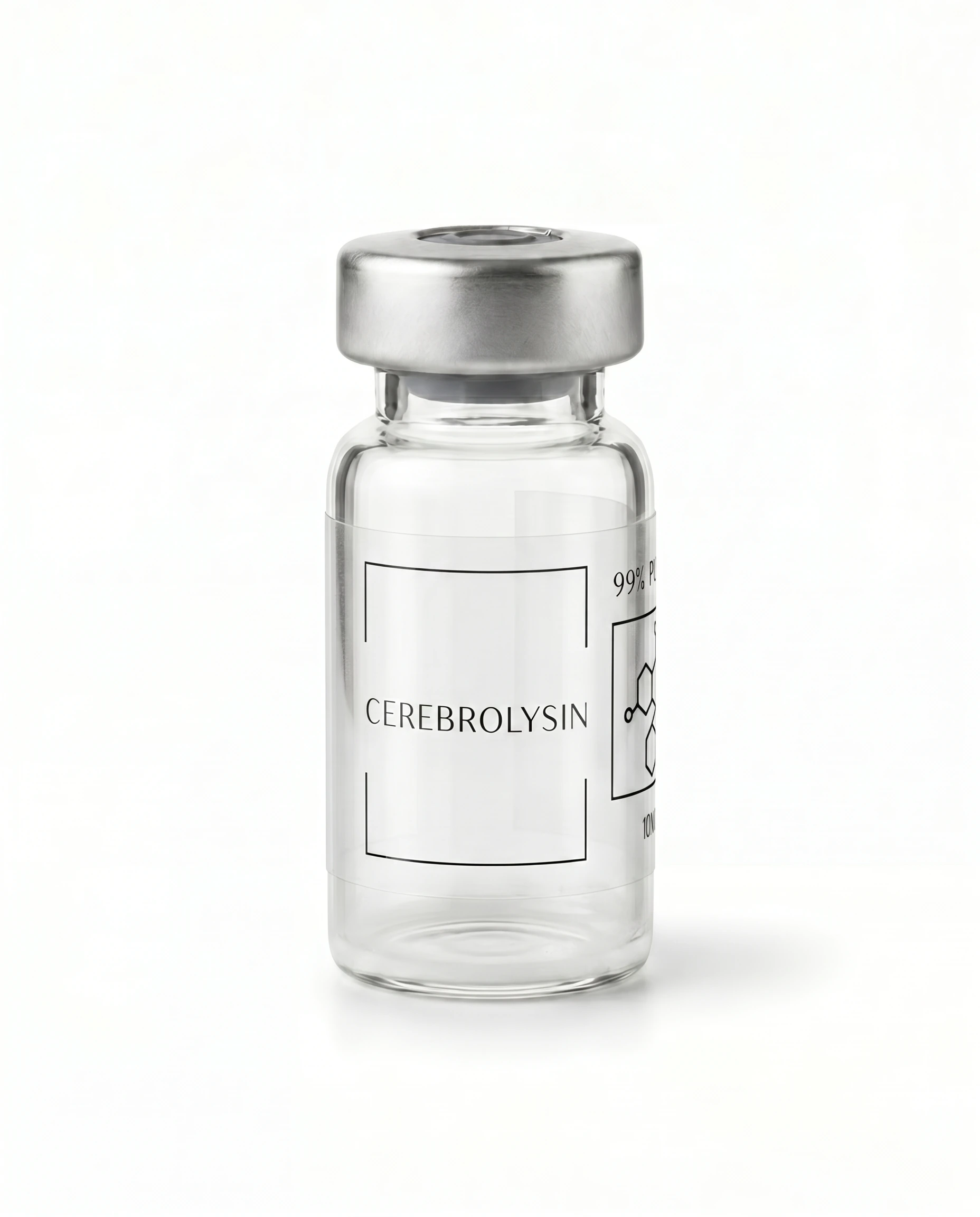
Cerebrolysin is a research peptide in the Cognitive & Nootropic class. Porcine-derived neuropeptide mixture; neurotrophic and neuroprotective. It is studied at per-dose ranges of 5–30 mL IM/IV (Per cycle weekly), administered daily for 10–20 days over cycles of 2× per year. Supplied in Thailand by Thailand Peptides, Bangkok-based, research use only.
Peptide preparation with neurotrophic-factor-like activity. Registered in Europe/Asia for stroke and dementia.
Published and preclinical data are summarised below; dose ranges shown reflect protocols in the research literature and should be interpreted accordingly.
How does Cerebrolysin work?
Cerebrolysin is a standardised, enzymatically produced mixture of porcine-brain-derived low-molecular-weight peptides and free amino acids. Its pharmacology mimics neurotrophic-factor (BDNF, NGF, GDNF) signalling in preclinical models, with effects on neuronal survival, synaptic plasticity, and neuroprotection under ischaemic insult. It is registered in the EU, Russia, China, and other Asian markets for stroke and dementia indications.
Receptor binding affinity and post-receptor signalling for Cerebrolysin remain areas of active investigation; several proposed effects within the Cognitive & Nootropic class are currently supported only by in-vitro or rodent data, and should be interpreted accordingly.
Cerebrolysin pharmacokinetics
- Half-life
- Product supplied as a mixture of low-molecular-weight peptides and free amino acids; individual component half-lives vary.
- Bioavailability
- IM and IV routes are the registered administration pathways; oral route not used.
- Route of administration
- Intramuscular or slow IV infusion daily for 10–20 days, typically 2× per year.
- Metabolic clearance
- Component peptides metabolised via standard proteolytic pathways.
Cerebrolysin research timeline
- 1980s Initial registration and clinical use in Central/Eastern Europe for stroke and dementia.
- 2010s Multiple Phase 3 trials in acute ischaemic stroke and vascular dementia published.
Cerebrolysin dosage & protocol
Reference protocol for Cerebrolysin (research context only, drawn from published literature):
- Per dose: 5–30 mL IM/IV
- Weekly total: Per cycle
- Frequency: Daily for 10–20 days
- Cycle: 2× per year
Cerebrolysin injection & handling
- Reconstitution
- Supplied in pre-filled ampoules of 5 mL, 10 mL, or larger; no reconstitution required.
- Storage
- Stored below 25 °C, protected from light.
- Sites used in the research literature
- Intramuscular (deep gluteal/thigh) for volumes up to 5 mL; larger volumes given as slow IV infusion per product monograph.
Handling notes reflect methods used in published research protocols, not medical dosing guidance.
Stacking Cerebrolysin
Commonly referenced pairing with Cerebrolysin: Semax. Stacking rationale should be grounded in complementary mechanisms, not additive speculation; interactions at shared receptors or enzymatic pathways should be accounted for. Both compounds in a Cerebrolysin stack are supplied by Thailand Peptides on the same order via the Bangkok research desk.
Contraindications
Status epilepticus. Additional caution is warranted in individuals with hepatic or renal impairment, endocrine disorders, or concurrent pharmacotherapy affecting the pathways described above.
Further reading
- Fundamentals · 10 min read How to Read a Peptide Certificate of Analysis A batch-level COA is the single most informative document about a research peptide. This guide explains HPLC purity, mass-spec identity, impurity…
- Fundamentals · 12 min read Peptide Storage, Handling, and Stability Lyophilized storage at −20 °C, reconstituted solution shelf life at 2–8 °C, freeze-thaw damage, and the cold-chain literature that applies to research…
- Buyer guide · 9 min read Best Peptides for Cognitive Function: A Research Comparison Research comparison of Semax, Selank, Cerebrolysin, and DSIP for cognitive-function and neurotrophic research.
- Deep dive · 11 min read Nootropic Peptide Mechanisms: A Research Overview Receptor-level comparison of the nootropic peptide class. Semax (ACTH-derived), Selank (tuftsin-derived), Cerebrolysin (porcine-brain peptide mix), and…
Citations
- Muresanu DF, et al. Cerebrolysin and Recovery After Stroke (CARS): A Randomized, Placebo-Controlled, Double-Blind, Multicenter Trial. Stroke. 2016. PMID: 26564102
- Heiss WD, et al. Cerebrolysin in patients with acute ischemic stroke in Asia: results of a double-blind, placebo-controlled randomized trial (CASTA). Stroke. 2012. PMID: 22282884
References curated from PubMed. Additional literature summarised in the Thailand Peptides research library.