Quick answers
What is Semax and what is it used for in research?
How does Semax work?
What is the typical Semax research dose?
Where can I buy Semax in Thailand?
How fast can Semax be delivered in Thailand?
What is Semax?
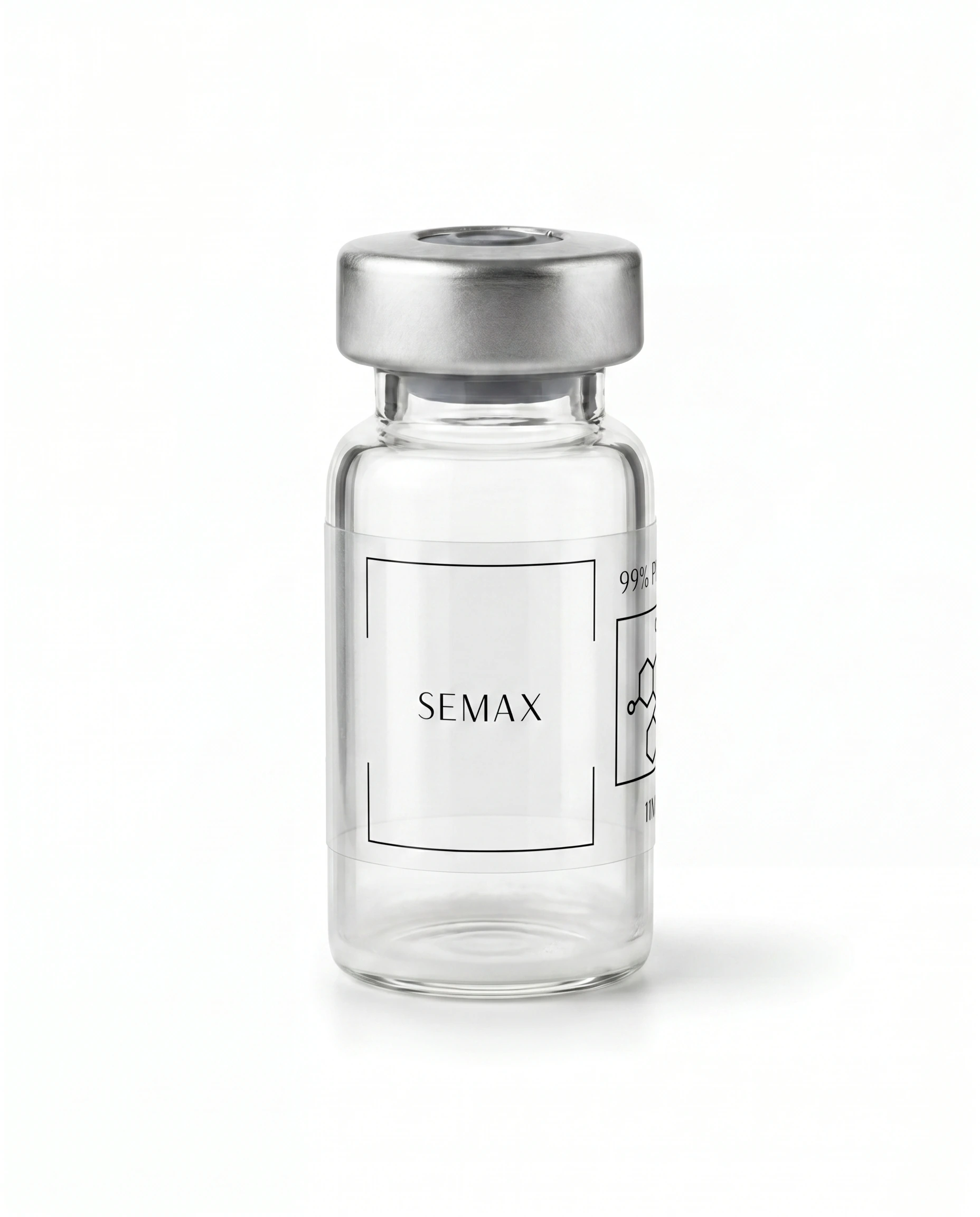
Semax is a research peptide in the Cognitive & Nootropic class. ACTH(4-10) analog; elevates BDNF and modulates monoaminergic tone. It is studied at per-dose ranges of 250–500 mcg × 2–3 / day (intranasal) (3.5–10 mg weekly), administered 2–3× daily intranasal over cycles of 14 days on / 14 off. Supplied in Thailand by Thailand Peptides, Bangkok-based, research use only.
Heptapeptide analog of ACTH fragment. Russian-registered for stroke recovery; studied for BDNF and NGF expression.
Published and preclinical data are summarised below; dose ranges shown reflect protocols in the research literature and should be interpreted accordingly.
How does Semax work?
Semax is a synthetic analogue of the ACTH(4-10) fragment with a C-terminal Pro-Gly-Pro extension that confers proteolytic stability. Research describes binding to brain BDNF- and NGF-related neurotrophin pathways, elevation of hippocampal BDNF expression, and modulation of monoaminergic (dopaminergic, serotonergic) tone. Russian registration is for ischaemic-stroke recovery and cognitive indications.
Receptor binding affinity and post-receptor signalling for Semax remain areas of active investigation; several proposed effects within the Cognitive & Nootropic class are currently supported only by in-vitro or rodent data, and should be interpreted accordingly.
Semax pharmacokinetics
- Half-life
- Short intranasal plasma half-life; central nervous system exposure persists beyond plasma clearance.
- Bioavailability
- Intranasal route provides direct nose-to-brain delivery; oral route not used.
- Route of administration
- Intranasal drops, 2–3 times daily in research and clinical protocols.
- Metabolic clearance
- Rapid peripheral proteolytic degradation.
Semax research timeline
- 2006 Dolotov et al., Semax binds specifically and elevates brain-derived neurotrophic factor (J Neurochem).
Semax dosage & protocol
Reference protocol for Semax (research context only, drawn from published literature):
- Per dose: 250–500 mcg × 2–3 / day (intranasal)
- Weekly total: 3.5–10 mg
- Frequency: 2–3× daily intranasal
- Cycle: 14 days on / 14 off
Semax injection & handling
- Reconstitution
- Typically supplied as intranasal solution; research material reconstituted in saline for intranasal delivery.
- Storage
- Refrigerated at 2–8 °C.
- Sites used in the research literature
- Intranasal, 1–2 drops per nostril 2–3 times daily in published protocols.
Handling notes reflect methods used in published research protocols, not medical dosing guidance.
Stacking Semax
Commonly referenced pairing with Semax: Selank. Stacking rationale should be grounded in complementary mechanisms, not additive speculation; interactions at shared receptors or enzymatic pathways should be accounted for. Both compounds in a Semax stack are supplied by Thailand Peptides on the same order via the Bangkok research desk.
Contraindications
None established. Additional caution is warranted in individuals with hepatic or renal impairment, endocrine disorders, or concurrent pharmacotherapy affecting the pathways described above.
Research summaries
Further reading
- Fundamentals · 9 min read Understanding Peptide Reconstitution: A Research Guide Practical guide to reconstituting lyophilized research peptides. Choosing a diluent, concentration math, injection-site-ready volumes, and the literature…
- Fundamentals · 10 min read Injection Site Selection in Peptide Research How injection site choice affects peptide absorption: abdomen, thigh, upper arm, and the research literature on site-driven pharmacokinetic differences…
- Buyer guide · 9 min read Best Peptides for Cognitive Function: A Research Comparison Research comparison of Semax, Selank, Cerebrolysin, and DSIP for cognitive-function and neurotrophic research.
- Deep dive · 10 min read Semax and Selank: BDNF Modulation in Research Models Deep-dive into the BDNF pharmacology of Semax and Selank. How two Russian-developed neuropeptides converge on BDNF and NGF expression in rat hippocampus…
Citations
- Dolotov OV, et al. Semax, an analogue of adrenocorticotropin (4-10), binds specifically and increases levels of brain-derived neurotrophic factor. J Neurochem. 2006. PMID: 16635254
References curated from PubMed. Additional literature summarised in the Thailand Peptides research library.