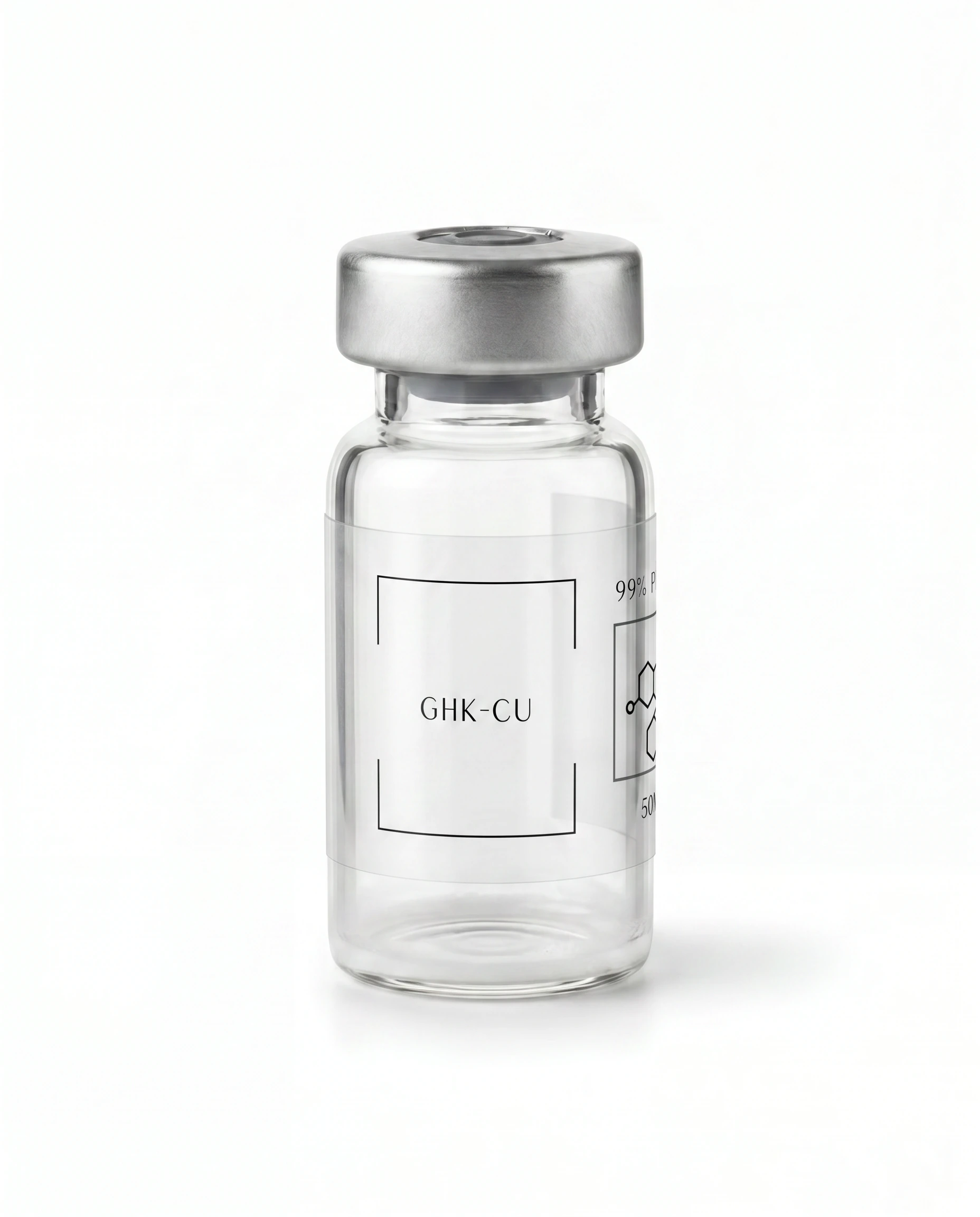
Quick answers
What is GHK-Cu and what is it used for in research?
How does GHK-Cu work?
What is the typical GHK-Cu research dose?
Where can I buy GHK-Cu in Thailand?
How fast can GHK-Cu be delivered in Thailand?
What is GHK-Cu?
GHK-Cu is a research peptide in the Longevity & Cellular class. Copper-binding tripeptide; modulates gene expression toward a younger phenotype. It is studied at per-dose ranges of 1–2 mg / day (7–14 mg weekly), administered daily sc or topical over cycles of ongoing. Supplied in Thailand by Thailand Peptides, Bangkok-based, research use only.
Naturally occurring copper-tripeptide. Declines with age; modulates ~4000 human genes in vitro.
Published and preclinical data are summarised below; dose ranges shown reflect protocols in the research literature and should be interpreted accordingly.
How does GHK-Cu work?
GHK-Cu is a naturally occurring copper-binding tripeptide (Gly-His-Lys) whose concentration declines with age. In vitro gene-expression profiling has identified modulation of approximately 4,000 human genes, including upregulation of genes involved in tissue remodelling, antioxidant defence, and anti-inflammatory pathways. Collagen synthesis, glycosaminoglycan production, and wound-healing endpoints are the most frequently cited research outcomes.
Receptor binding affinity and post-receptor signalling for GHK-Cu remain areas of active investigation; several proposed effects within the Longevity & Cellular class are currently supported only by in-vitro or rodent data, and should be interpreted accordingly.
GHK-Cu pharmacokinetics
- Half-life
- Short circulating half-life for the copper-bound tripeptide; topical absorption rates vary by vehicle.
- Bioavailability
- Both SC and topical application used in research; topical penetration modulated by formulation.
- Route of administration
- Subcutaneous injection or topical application (cream, serum) in research and cosmetic formulations.
- Metabolic clearance
- Rapid proteolytic degradation of the Gly-His-Lys sequence; copper retained by serum ligands.
GHK-Cu research timeline
- 1970s Pickart, original isolation and characterisation of GHK from plasma.
- 2012 Pickart et al., GHK-Cu gene-expression profiling in human cells (review literature).
GHK-Cu dosage & protocol
Reference protocol for GHK-Cu (research context only, drawn from published literature):
- Per dose: 1–2 mg / day
- Weekly total: 7–14 mg
- Frequency: Daily SC or topical
- Cycle: Ongoing
GHK-Cu injection & handling
- Reconstitution
- Typical research prep: 50–100 mg vial + bacteriostatic water to a working concentration (e.g., 10 mg/mL).
- Storage
- Lyophilised powder at −20 °C protected from light; reconstituted solution refrigerated, with copper complex generally stable for 2–4 weeks.
- Sites used in the research literature
- Subcutaneous abdomen for injection; topical application to target skin region.
Handling notes reflect methods used in published research protocols, not medical dosing guidance.
Stacking GHK-Cu
Commonly referenced pairing with GHK-Cu: Topical + SC. Stacking rationale should be grounded in complementary mechanisms, not additive speculation; interactions at shared receptors or enzymatic pathways should be accounted for. Both compounds in a GHK-Cu stack are supplied by Thailand Peptides on the same order via the Bangkok research desk.
Contraindications
Wilson's disease. Additional caution is warranted in individuals with hepatic or renal impairment, endocrine disorders, or concurrent pharmacotherapy affecting the pathways described above.
Further reading
- Fundamentals · 9 min read Understanding Peptide Reconstitution: A Research Guide Practical guide to reconstituting lyophilized research peptides. Choosing a diluent, concentration math, injection-site-ready volumes, and the literature…
- Fundamentals · 12 min read Peptide Storage, Handling, and Stability Lyophilized storage at −20 °C, reconstituted solution shelf life at 2–8 °C, freeze-thaw damage, and the cold-chain literature that applies to research…
- Buyer guide · 9 min read Best Peptides for Anti-Aging: A Research Comparison Research comparison of Epithalon, MOTS-c, GHK-Cu, Thymosin-α1, and NAD+ for longevity and cellular-aging research. Bangkok research-grade.
- Deep dive · 9 min read GHK-Cu Research: Copper-Peptide Mechanism and the Skin-Regeneration Literature GHK-Cu tripeptide mechanism, copper-binding pharmacology, Pickart skin regeneration research, gene-expression effects, and the lab-use research context.
Citations
- Pickart L, et al. GHK Peptide as a Natural Modulator of Multiple Cellular Pathways in Skin Regeneration. Biomed Res Int. 2015. PMID: 26236730
- Pickart L. The human tri-peptide GHK and tissue remodeling. J Biomater Sci Polym Ed. 2008. PMID: 18644225
- Pickart L, et al. The Effect of the Human Peptide GHK on Gene Expression Relevant to Nervous System Function and Cognitive Decline. Brain Sci. 2017. PMID: 28212278
References curated from PubMed. Additional literature summarised in the Thailand Peptides research library.