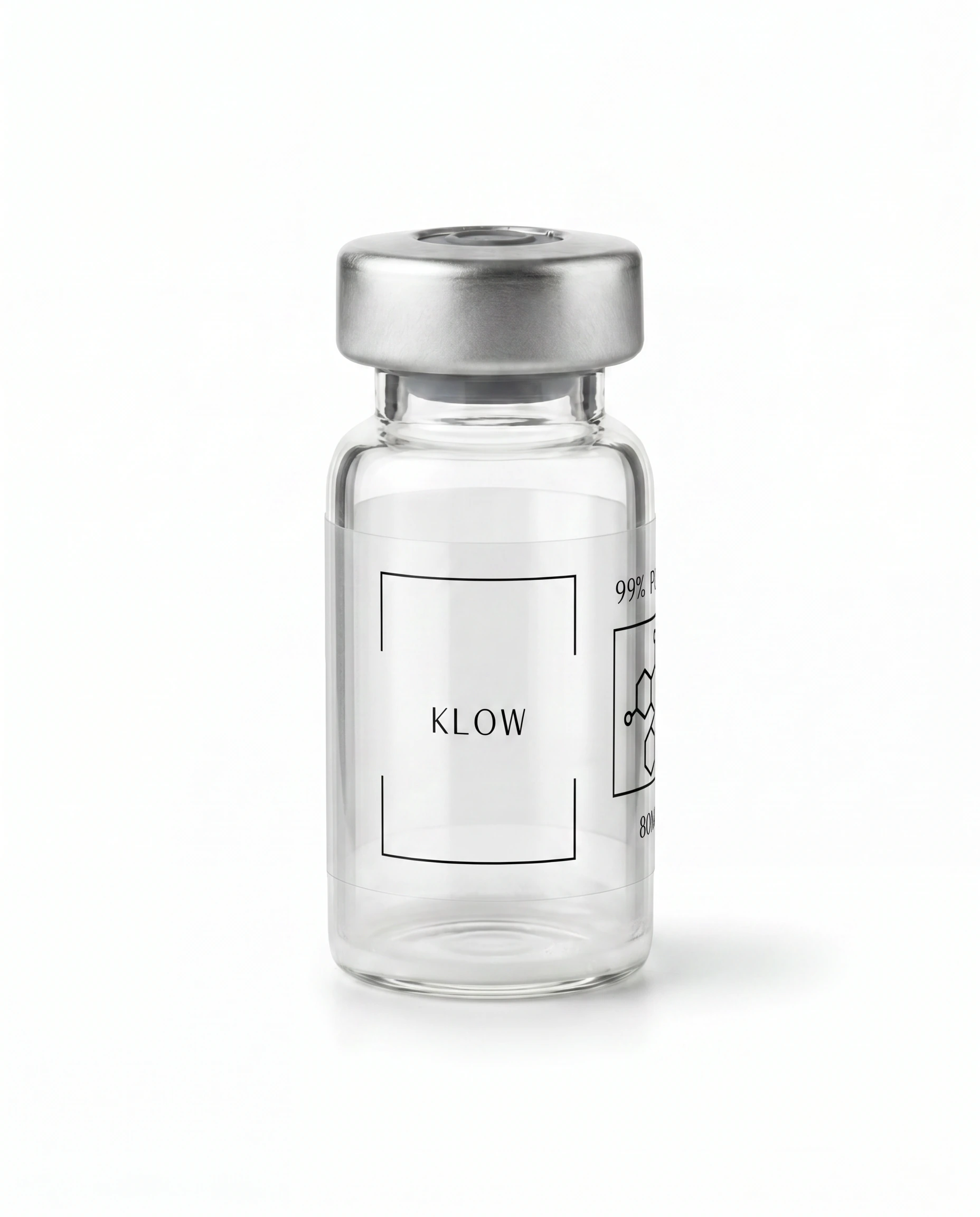
Quick answers
What is Klow and what is it used for in research?
How does Klow work?
What is the typical Klow research dose?
Where can I buy Klow in Thailand?
How fast can Klow be delivered in Thailand?
What is Klow?
Klow is a research peptide in the Blends & Stacks class. Four-component blend: BPC-157, TB-500, GHK-Cu, KPV; pre-stacked repair + angiogenesis + gene-modulation + anti-inflammatory mechanisms. It is studied at per-dose ranges of Per-component variable; typical blend 250–500 mcg / day (1.75–3.5 mg weekly), administered daily sc over cycles of 4–6 weeks. Supplied in Thailand by Thailand Peptides, Bangkok-based, research use only.
Co-formulated research blend of (1) BPC-157 — pentadecapeptide investigated for tendon, ligament, and gut-mucosal repair; (2) TB-500 — Thymosin-β4 fragment that drives actin polymerisation, angiogenesis, and cell migration; (3) GHK-Cu — naturally occurring copper tripeptide that modulates ~4000 human genes toward a regenerative phenotype; (4) KPV — α-MSH (11–13) tripeptide with studied anti-inflammatory activity in gut and skin models. Designed for compound tissue-recovery and anti-inflammatory research protocols.
Published and preclinical data are summarised below; dose ranges shown reflect protocols in the research literature and should be interpreted accordingly.
How does Klow work?
Primary mechanism: Four-component blend: BPC-157, TB-500, GHK-Cu, KPV; pre-stacked repair + angiogenesis + gene-modulation + anti-inflammatory mechanisms. Research on Klow implicates downstream effects on related signalling cascades, with magnitude and clinical relevance dependent on dose, timing, and individual pharmacogenomic factors.
Receptor binding affinity and post-receptor signalling for Klow remain areas of active investigation; several proposed effects within the Blends & Stacks class are currently supported only by in-vitro or rodent data, and should be interpreted accordingly.
Klow dosage & protocol
Reference protocol for Klow (research context only, drawn from published literature):
- Per dose: Per-component variable; typical blend 250–500 mcg / day
- Weekly total: 1.75–3.5 mg
- Frequency: Daily SC
- Cycle: 4–6 weeks
Stacking Klow
Commonly referenced pairing with Klow: Standalone (already combined). Stacking rationale should be grounded in complementary mechanisms, not additive speculation; interactions at shared receptors or enzymatic pathways should be accounted for. Both compounds in a Klow stack are supplied by Thailand Peptides on the same order via the Bangkok research desk.
Contraindications
Active malignancy, Wilson's disease. Additional caution is warranted in individuals with hepatic or renal impairment, endocrine disorders, or concurrent pharmacotherapy affecting the pathways described above.
Citations
- Sikiric P, et al. Stable gastric pentadecapeptide BPC 157: novel therapy in gastrointestinal tract. Curr Pharm Des. 2011. PMID: 21548867
- Goldstein AL, et al. Thymosin β4: a multi-functional regenerative peptide. Expert Opin Biol Ther. 2012. PMID: 22074294
- Pickart L, et al. GHK Peptide as a Natural Modulator of Multiple Cellular Pathways in Skin Regeneration. Biomed Res Int. 2015. PMID: 26236730
- Kannengiesser K, et al. Melanocortin-derived tripeptide KPV has anti-inflammatory potential in murine models of inflammatory bowel disease. Inflamm Bowel Dis. 2008. PMID: 18092346
References curated from PubMed. Additional literature summarised in the Thailand Peptides research library.